
Table of Contents
- Does Fish Leather Smell Like Fish? The Direct Answer
- Why Some Leather Goods Smell Fishy
- How to Identify What Your Item Is Actually Made Of
- The Fish Leather Tanning Process and Why It Matters
- How to Clean Fish Leather Without Causing Damage
- Everyday Fish Leather Care to Prevent Odors
- Conclusion
- Frequently Asked Questions
Last Updated: October 9, 2026
Does Fish Leather Smell Like Fish? The Direct Answer
Properly tanned fish leather does not smell like fish, the answer we give most often at Fiskur Leather.
Fish leather is made from the skin of salmon, tilapia, or trout, tanned to remove oils the same way cowhide is treated.
So why do so many people search does fish leather smell like fish? Because they bought something that smelled odd.
Why Some Leather Goods Smell Fishy
A fishy smell on any leather item points to one of three sources: adhesives, dyes, or a weak tanning job. It is a symptom, not a material flaw, and finding the source usually lets you fix it.
Adhesives, Dyes, and Chemical Treatments
Glue is the most common culprit. Many bags and wallets use adhesive to hold linings and edges in place.
Dyes and coatings can do the same. A low-quality finish may release a chemical smell people describe as fishy or sour, especially in faux and PU leather.
If the smell is strongest near a seam or edge, glue is likely the source. If it comes from the whole surface, suspect the dye or coating.
Manufacturing and Tanning Problems
A weak tanning process leaves proteins and oils in the skin. Those residues break down over time and give off a fishy smell, the real reason some fish leather smells.
Cheap manufacturing skips steps to save time and money. Degreasing, which strips away fish oil, is often the first step cut.
This is why the smell is not about the fish. It is about how the skin was handled.
How to Identify What Your Item Is Actually Made Of
Most people cannot tell fish leather from faux leather by look alone.
Here is a quick way to sort out what you have:
- Genuine fish leather: Fine, even scale pattern; soft and flexible; no fishy smell when clean
- Genuine cowhide: Smooth or pebbled grain; heavier feel; smells like leather, not fish
- Faux leather (PU leather or pleather): Uniform plastic surface; back is fabric; may smell chemical
Check the back of the material. Real leather has a fibrous, suede-like back.
Look at the edges: genuine leather looks solid and slightly rough, while synthetic often shows a fabric core.
If the label says "PU," "polyurethane," or "synthetic," you are not holding fish leather.
The Fish Leather Tanning Process and Why It Matters
Tanning turns a raw fish skin into stable leather.
After tanning, the leather is dyed, finished, and dried. Each step affects how the final material smells and how long it lasts.
Our Lunker Leather line uses oak gallnut extract, Tara, or willow bark to tan skins by hand with natural dyes, avoiding the harsh chemical smell some factory methods leave behind.

The Leather Working Group's guidance on responsible leather production outlines how tanning choices affect both durability and odor.
A fishy smell is not a property of fish leather. It is a property of a shortcut.
How to Clean Fish Leather Without Causing Damage
Fish leather is a protein-based material with a finished surface, so the wrong cleaner can do more harm than the odor itself. Identify the material first, because the safe method for genuine fish leather is not safe for PU or PVC faux leather.
Match the Remedy to the Material
- Genuine fish leather (salmon, tilapia, trout): Protein-based, finished with dyes and a top coat. It tolerates brief, controlled moisture but not soaking, alcohol, acetone, or abrasive pads.
- PU (polyurethane) faux leather: A plastic coating over a fabric backing. It resists water better than real leather but can delaminate, crack, or haze when exposed to solvents, heat, or scrubbing.
- PVC (polyvinyl chloride) faux leather: The stiffest and most chemical-smelling of the three. It often off-gasses for weeks; heat accelerates the release but warps the material, so ventilation, not heat, is the right tool.
If the label says PU, polyurethane, PVC, or synthetic, treat the item as plastic, not leather. Vinegar, conditioners, and leather balms are unnecessary and can leave residue on a plastic surface.
Diagnose the Odor Before You Treat It
Different sources need different fixes. A single remedy applied to the wrong cause can set the smell in deeper.
- Adhesive odor (sharp, solvent-like, strongest at seams and edges): Usually still curing. Air is the fix; liquids can push glue residue into the lining.
- Dye or top-coat odor (chemical, sour, present across the whole surface): Often fades with ventilation over one to three weeks. Do not scrub, which can lift the finish unevenly.
- Residual protein odor (faintly fishy, musty, worse when damp): Points to incomplete degreasing during tanning. This is the one case where the material itself is the source, and it rarely resolves with home treatment.
A Safe Deodorizing Sequence
Work from least to most invasive, and stop as soon as the odor is gone.
- Air it out. Place the item in shade outdoors or in a well-ventilated room for 24 to 48 hours. Avoid direct sun, which fades dye, and avoid sealed plastic bags, which trap odor.
- Wipe dry first. A soft, dry microfiber cloth removes dust and surface residue before any liquid is introduced.
- Stuff with plain newspaper. Crumpled black-and-white newsprint wicks odor from the interior. Avoid glossy inserts, which can transfer ink. Leave for 24 hours, then replace.
- Try diluted white vinegar, genuine leather only. Mix one part white vinegar with three parts distilled water. Wring a cloth until it is nearly dry, wipe gently with the grain, and let the item air-dry away from heat. Do not saturate, and do not use vinegar on PU or PVC, where it can dull or streak the coating.
- Use baking soda as a dry absorbent. Place the item in a container with an open dish of baking soda nearby, not poured onto the leather, for 24 to 48 hours. Direct contact with powder can dry out or discolor the finish.
- Condition genuine leather only. After any moisture exposure, a light application of a neutral leather conditioner restores suppleness. Skip this step entirely on faux leather.
What Not to Do
- No heat. Hair dryers, radiators, car dashboards, and direct sun can crack finishes, warp shapes, and accelerate adhesive breakdown.
- No alcohol, acetone, bleach, or ammonia. These strip dyes and top coats on genuine leather and haze or craze plastic coatings.
- No washing machines, soaking, or submerging. Water saturation can delaminate faux leather and stiffen genuine leather as it dries.
Test First, Always
Apply any liquid to a hidden area, inside a pocket flap, under a strap, or along an interior seam, and wait 24 hours. Check for color shift, stiffness, or finish lifting; if the test patch changes, stop and use dry methods only.
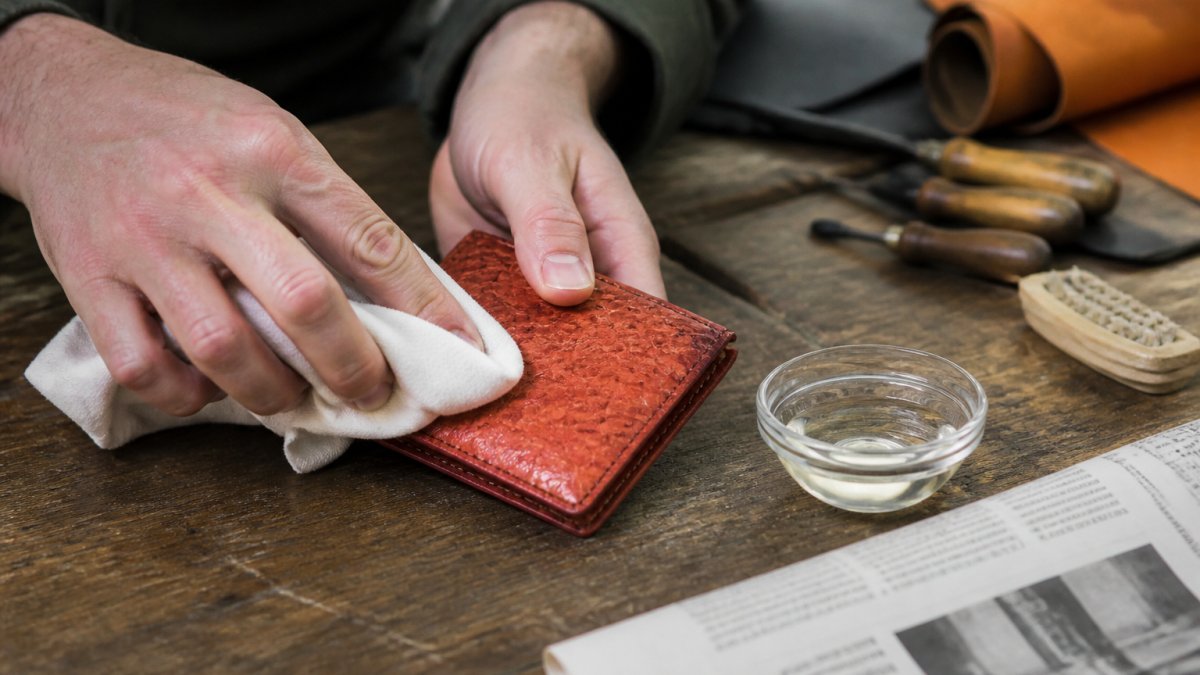
Proper maintenance ensures that the natural fibers remain supple over time, a principle that remains central to understanding leather durability across various sustainable material alternatives.
Everyday Fish Leather Care to Prevent Odors
Prevention beats treatment. A few habits keep fish leather fresh and free of odor.
Store items in a cool, dry place. Damp storage invites mold and musty smells.
Let items dry fully before storing them.
Clean gently and rarely. Over-cleaning wears down the finish.
Rotate your pieces. Leather that sits untouched for months can pick up a stale smell.
Conclusion
A fishy smell on leather is a signal, not a sentence. It points to glue, dye, or a rushed tanning job, not to the fish itself. When the material is made well, that smell never shows up.
At Fiskur Leather, we have handcrafted fish leather goods since 2011, using natural tanning methods and sustainable materials. Our Salmon leather and Lunker Leather are made to last and made to smell like nothing at all. If you want a piece that proves the point, shop our collection and see for yourself.

Frequently Asked Questions
Does properly tanned fish leather smell like fish?
No. When fish leather goes through proper tanning and degreasing, the fishy odor disappears. The skin is preserved, not the smell. A well-made fish leather wallet or bag should smell like leather, not like the fish it came from. If you notice a fish leather smell on a new item, it usually points to a tanning or finishing step that was rushed rather than the material itself.
Why does my fish leather wallet or bag have a fishy smell?
A fishy odor on a new item often comes from adhesives, dyes, or coatings rather than the leather itself. Some manufacturers use glues and chemical treatments that release an unpleasant odor as they cure. Poor storage or moisture can also trap smells inside the material. In many cases, the odor fades after a few days of airing out, but a strong, persistent smell can point to a tanning problem.
How can I remove a fishy odor from fish leather safely?
Start by airing the item outdoors in a shaded, ventilated spot for 24 to 48 hours. Avoid direct sunlight, which can dry out or discolor the leather. Place newspaper inside bags or wallets to absorb moisture. Never soak fish leather or put it in a washing machine, since water can damage the material.
Is a strong fishy smell a sign that fish leather was poorly tanned?
It can be. Proper tanning includes degreasing, which removes the oils and proteins that carry the fish odor. If that step is skipped or rushed, the smell lingers. A faint new-item smell that fades within a week is normal. A strong, fishy odor that lasts longer, or returns after cleaning, suggests the item was not fully tanned and is worth returning or exchanging.
A fishy smell should never be part of the deal. If you have been burned by poorly made leather before, you deserve better. Fiskur Leather offers handcrafted goods with natural tanning, durable construction, and custom orders made to your specs. Get started with Fiskur Leather and own a piece that holds up and smells clean.
Leave a comment